Tuesday, 7 February 2012

Mammallapurum to Mangalore: Part I


At 1 pm I heaved my backpack onto my back and strode through the main tourist street of Mammallapurum past the shops selling ali baba pants, embroidered shirts of the thinnest cotton, mirrored sling bags, and all varieties of hand-carved trinkets from palm-sized to big enough to fill a palace.  I turned left at the major intersection and made my way to the cement slab of a bus stand.

Then the fun and games started.

"Trivanmiyor," I said to a man standing by an empty bus, and pulled out the slip of paper on which I had someone write it out in Tamil.  He waggled his head from side to side which I was just beginning to conclude signified an affirmative, but the waiving of his hand toward the other end of the urine-saturated bus lot led me to believe he was telling me  "No."

Another man, an older man with close-cropped gray hair and a bushy mustache quickly shuffled over to me and began speaking a language I thought may have been English, but sounded like nothing I had ever heard before.  He repeated a word which I thought may have actually been the name of the town I was heading toward, and insistently pointed to the bus on his left.

"Thank you," I said looking around and finally spotting the "Enquiries" booth.  Three officials in khaki-green uniforms and pan-reddened lips and teeth stood around laughing and talking and spitting red pan juice onto the red-spotted earth.  One finally motioned to me.  I told him I wanted a bus to Trivanmiyor.  He leafed through a wel thumbed-through list of time schedules and told me to take the #559 at the corner.

Meanwhile my diligent caretaker had followed me over and seemed very agitated at this piece of information given to me.  With authority he spoke to the official who had told me to take the #559.  The official looked up at the gray-haired man, consulted his two colleagues and said: "Take this bus.  (The one originally indicated by the gray-haired man.) It leaves in fifteen minutes."

The gray-haired man trailed me over to the bus and continued with seemingly the very best of intentions to try and impart further instructions in a garble of unintelligible jabber

"Thank you. Thank you," I said as I heaved myself and my pack up the incredibly steep first step of the bus.

The bus filled and in fifteen minutes it pulled out from the original spot but then was ordered to stop next to the another bus at the main street.  The bare-foot bus driver pulled both his legs up onto the seat and sat cross-legged until one man in charge blew his whistle and we were off with a lurch and bounce and a jostling of passengers.

For two and a half hours I rode in relative comfort sharing my seat with only one lady as was the intention for this small two-person seat, but which in the past has had to seat three.  I got off at Trivanmiyor and stood among a mob of waiting passengers on a busy inner-city street corner.

When th A1 bus to Chennai Central Railroad Station arrived, passengers hurled themselves in the open side door.  I should have been suspicious about why nobody sat on the slightly raised seat just inside the back door of the bus, but it was the perfect height to slip my backpack onto while I perched on its edge.  Male passengers looked over at me, but then again most of the time I'm the only non-Indian riding local busses and tend to get a lot of curious lookers.

The ticket seller took my money, handed me my print-out, said nothing, and blew his shrill whistle two times indicating that the driver could take off.

At each stop more and more people jammed into the bus and suddenly the ticket taker motioned impatiently for me to get the hell out of HIS seat.  I swung my pack off the seat and squeezed it through the crowd onto the floor of the bus where its padded waist belt straps sprawled out like huge crab claws across the feet of the standing passengers.  Everybody leaving had to step over it.  Everybody entering had to step over it.  Everybody leaving and entering looked from it to me and back again several times as I smiled apologetically and repeatedly made redundant efforts to do something to alleviate its intrusion.

Finally "Central!  Central!" was called out by the ticket taker.  I lifted my scuffed and foot-printed pack and made my way into the railway terminal.

My train- The Chennai-Mangalore Express" was listed as "on time," which was a great relief as in my last sleeper train experience two years ago, my train from Margao to Kochi was delayed six hours, stranding me in the "Good Ladies Special Waiting Room" where I sat among the mothers and children and watched a group of good ladies play charades.

The Chennai-Mangalore Express slowly chugged onto platform 3 at 4:30pm.  I reread the car and berth number on my print-out but had to ask a young man which car to board.  With smiling good manners he showed me to my car, wished me a "Pleasant journey, Madame," and I heaved myself and my pack up the steep narrow steps and into the train.

I found #57 while Indian families rushed aboard as if finding their seat was a competitive sport.  A short, thin Indian man with a short-cropped beard and mustache, kind black eyes, a plaid button-down shirt, and brown trousers sat by the window with three iron bars across it on the faded-blue seat across from #57. I showed him my ticket and he gently assured me I was in the right place--the non-AC, 3 tier sleeping car, seat 57, lower berth.

Next, two men in dazzling white came and sat down on the end of our benches, across from each other.  Attired identically they wore pure white linen short-sleeved button-down shirts, ironed with a crisp crease across the sleeves, and bleached to an eye-searing whiteness.  They both wore slightly less white longyis--an ankle-length sarong wrapped around their waists.  Both were white-haired, their hair cropped short.  Serious men, they spoke little and spent a good deal of time gazing down at their thick hands that lay on their white-draped laps, fingertips touching.

Then a mother and university son sat opposite each other, between me and Mr. White and the little Indian man and the other Mr. White on the faded blue benches.

Meanwhile Indian families strode through, looked at numbers on the wall, looked at us, shouted, questioned, and moved on as hawkers sallied through announcing their goods: children's books, toys. games. bottled soft drinks.  Canisters of sweet milky tea and coffee were carried through and touted.  Women beggars, babies astride one hip came through making the universal gesture for food: fingers and thumb pressed together, their hand going to and from their mouths.

A loud "thunk," a lurch and at precisely 5 pm the train groaned in the first chug of its sixteen hour haul across Southern India.

Several hours later, when the "biryani" man made his appearance in our car yelling: "Biryani! Biryani! Veg! Chicken!" he was welcomed with orders from all of us.

One by one as my fellow passengers finished their meal, they left their seats carrying their aluminum and cardboard biryani containers with them and returned empty-handed, wiping their mouths.  When I had eaten all I could, I too got up and walked in the same direction.  Below the sink, where in other trains there had been a a trash container, there was only empty space.  I walked through to the next car but it also lacked a trash receptacle.  I cautiously opened the latch to the "Western Toilet," and found only a western toilet and a sink.  I did the same to the door merely marked "Toilet," and saw only a hole in the floor of the train with two metal runged foot slots on either side and a sink.

I stood holding my biryani container staring around in bewilderment when the university son came up to me.

"What is wrong, Madame," he asked.
"I can't find a place to throw this, " I said holding up my biryani container.
He looked all the places where I had already looked and found the same thing I found.  There were no trash receptacles.
"Usually there is a place under the sink, but this train hasn't got one," he said.
I continued to stand, biryani container in hand.
"You must throw it out the door," he said.
I looked at him in dismay.
"Yes, Madame.  No other way.  Just do it, Madame." He was starting to sound like a Nike ad.
Still I held back from littering and adding more rubbish to India's piles of trash.
"Madame, you can do it," he urged me.  "Throw, Madame, throw!"

I suddenly felt infused with his eager encouragement.  It had become an Olympic event, and I could do it!  My companion was urging me on to new heights.
"Throw, Madame, throw!:"
In a burst of enthusiasm I hurled the biryani container out the open door of the chugging train watching its aluminum catch the moonlight and momentarily shine like a hurled discus riding the wind.

"Very good, Madame," my companion commended my sterling effort at littering.

Sunday, 5 February 2012

Culture Shock!

When I first kicked off my sandals, walked up the flight of stairs and entered the German Bakery in Thiruvannammalai, I thought I had accidentally interrupted a meditation session.  Everyone's back was to me as people sat gazing at holy Mt. Arunachala.  Soothing Indian mantras played over the sound system.  "Om shanti om shanti om shanti om."  From the terrace of the guesthouse opposite a man in a red loin cloth did yoga. And all the people adorned in varying arrangements of soft Indian clothing soaked in the holiness of the holy mountain. 

After 2 weeks of soaking up all the spirituality of Tiru (or Guru Junction as I like to call it), I was pretty much saturated with goodness and light and decided to hit the road.  Mammallapurum, is like Tiru, an enclave of foreigners, but with some major differences.  Mammallapurum is touted to be an "artists's colony.  Indeed, everywhere in the tiny town you can hear the tuk tuk tuk of hammers hitting stone as men fashion carvings, sculptures large and tiny.  Ganeshes and Hanumans, Shivas and Lakshmis.   

In search of some coffee, I entered the German Bakery in Mammallapurum.  I sat down at an outside table. First shock: pounding bass and driving unaltering beat of drum machines. A rapper spits out the lovely lyrics: "Hey bitch, I wanna slap yo mother-fuckin ass."  And all the tourists are clad not in flowing saffron sarongs, ali baba pants and draped shawls.  No.  They're wearing normal western wear.

I think it's time to return to Gokarna and rejoin my lost tribe.

Thursday, 2 February 2012

from Thiruvannamalai to Pondicherry India

Hawkers enter the public bus displaying their goods, shouting out the name of their edibles: samosas, bagged sweets, deep fried lentil puffs; urging the passengers to buy trinkets or charms of one of the 330 million Hindu deities.  I'm the only non-Indian in the bus. Many eyes scan me with curiosity. 

As I turn to see what all the hawkers are yelling about, a young man whose face and upper body are painted with red and white circles enters the bus.  A thin stick seems to magically protrude vertically in front of him.  But how?

Then I see. The stick (about four feet long)goes through the middle of his tongue. He moves his swollen tongue and the stick moves slightly forward and back.

The bus driver and and the first row of passengers (all male) watch me watching this man.  They laugh and look back and forth from me to the boy.  I'm sitting in the very front seat: a single seat on the opposite side of the engine from the driver.  Suitcases, bags of grain, luggage, wrapped parcels lean against the engine creating an island of goods separating me from the rest of the bus.  Stick-tongue boy moves toward me, but can't reach me.  The driver and first row of men yell to him.  He walks out of the bus and stands outside my window thrusting a gold-wrapped box toward me. 

I sort through my wallet, find a 5 rupee coin, reach through the horizontal metal slats of the window and drop the coin through the slot in the top of his box. The bus driver and front row men smile, nod, laugh.


The driver starts the engine and we begin the three hour ride.

Villages, rice fields, hills made up of boulders stacked one upon the other zoom past.  Rice fields of life-screaming-affirmation yellow-green. Yaks pulling carts stacked with cotton bags stuffed with goods.  Trucks piled with loads of twigs and branches strapped down and fanning out over their sides. 

A motorbike man almost eclipsed by the panoply of multi-colored plastic goods tied onto his bike put-puts by.

The bus rattles and bounces along the pot-holed two-lane blacktop road.  My head swirls with ecstatic prose: rhapsodies to the beauty of India's countryside and people.  My pulse beats to the rhythm of the engine. I sing a song of silent words in praise of life.

Wednesday, 1 February 2012

Arunachaleswar Temple, Thiruvannamalai, India

I walk along the dusty main street into town, dodging cows and calves, side-stepping cow patties, weaving my way around rickshaws, and arrive at the Arunachaleswar Temple.  Four large gopurams occupy four cardinal points in this complex.  Hindu pilgrims come here to worship Lord Shiva, who appeared as a column of fire atop Mount Arunachala which rises  behind the temples highest gopuram.

Darshan (ritual prayers) are underway when I arrive.  A group of about forty bare-chested men clang finger cymbals, tambourines and beat drums as they chant.  Their upper bodies gleam with coconut oil.  Intense jade-green sarongs are wrapped around their waists.  Sandalwood beads strung around their necks. Framing them on either side are groups of female pilgrims dressed in flaming-red saris, garlands of flowers--jasmine, marigolds and roses woven into their thick black braids. 

Other pilgrims are dressed all in white.  Some men with shaven heads anointed in a yellow paste. 

At noon bells clang, drums beat, voices raise in a repetitive, two-syllable cry as the faithful offer their prayers to Shiva.

Some red-clothed children in the serpentine line to enter the temple spot me as I sit and write on the marble steps of the sheltered arcade opposite.  I smile and wave.  They cover their mouths and giggle, wave back.  I wave again and they wave harder.  A group of the youngest skip in my direction, then scurry away in a fit of shyness.s  They make more tentative forays and retreats waving and grinning.  Finally a mother and six children all attired in flaming red walk over to me, the littlest children hiding behind the mother's sari.


"Thank you, hello," they say. giggling.
"Hello, thank you," I return.
We continue about five rounds of this.
The mother says, "I mother," points to man now walking towards us, "He husband."
I shake the soft Indian hand shake with all of them.
"This my son, my daughter," the husband says.  "Other - my brother's children.  We are two families."
"Nice to meet you," I say.
"Nice to meet you," echo all the family members.
"What is your good name, Madame," asks the father.
"Diane," I answer.
"Diane. Diane. Diane." echo the family.
"We take photo?" The husband points to family and me.
"Oh," I say, "I thought no photos were allowed in the temple.
"Yes.  Yes.  Sorry.  You are correct.  I forgot.," he says.

Bells clang.
They all turn to see where the rest of their family is in the queue, then turn back to me, raise their hands to their faces, say: "Nameste," and scurry off.

I lean back against the pillar, appreciate the cool breeze, and study the reliefs of melon-breasted women, flowers and elephants etched into the columns.

Monday, 23 January 2012

from Hippie Heaven to Guru Junction, Thiruvannamalai, India

They come here in pain.  Seeking relief.  Seeking truth.  Seeking something they suspect exists but cannot name; something they once glimpsed out of the corner of their eyes on one bright spring day.

For some the pain is emotional.  Pain from the past that has fouled their vision like a polluted pond.  For some the pain is mental.  A stabbing diatribe like a sharp stone in your shoe on a never-ending hike up a steep mountain.  For some it's grief or loss.  For others it's the pain of inadequacy.

Some feel lost.  All are searching for a path to the light.

"I just woke up one day and nothing made sense anymore.  All the things I'd worked for.  The things I'd accumulated.  Suddenly none of it meant anything to me.  I just felt empty." A healthy-looking, gray-haired man of about sixty tells the two people sharing the table at the German Bakery.

The "German Bakery" is run by Tibetans.  You walk up one flight of stairs, take off your shoes, and enter to the sounds of gentle Indian music.  One song - one chant repeated to the end of the song.  All the customers sit in multi-colored plastic chairs facing the "holy" mountain.  Mount Arunachala. The mountain outside Thiruvannamalai where Ramana Maharshi sat meditating in a cave for seventeen years.  Needless to say, when he finally exited, he had rid himself of all the excess mental and emotional garbage most mortals carry around with them.  He was "enlightened."

People come to the German Bakery for their fruit salads, mueslis, or whole grain toast and herbal tea before they set off to "Satsang."  "Satsang" is the practice of sitting with a teacher or "guru" as individuals come forward to ask questions and receive clues to wake them out of their dark slumbers.

I come curious.  I come open.  I come skeptical but interested.  After all, life is about new and different experiences.  Isn't it?

Mooji enters the silent hall.  Four hundred seekers sit cross-legged on the floor.  He takes the chair on the stage.  He is short and squat.  Caribbean with massive dreadlocks pulled into a mound at the back of his head, a few straggler dreads hanging down his back, a salt and pepper beard and mustache and an unflappable demeanor.

He wraps his microphone around his head, adjust it and looks out into the crowd.  When he makes eye contact he bursts into a smile that starts in his eyes and radiates to his lips.  He has a contagious chuckle.  Within seconds I find myself totally loving this guy.

"I am all the time suffering pain," one Russian man tells Mooji when he comes forward to the stage.
"I don't feel like I belong anywhere," a German woman shares.
"I reach moments  where I experience the "now" but then I'm back in my thoughts," an Australian man says.

Unpretentious, a great story-teller, with a great sense of humor and no-nonsense words that strike the bull's eye of human existence, Mooji looks at the person sharing with total acceptance and love.  He asks questions  that lead them on a path of discovery.  He invites them to let go of the thoughts that keep them prisoners.  He provokes each to a greater experience of expanded consciousness.

There is no fee for sitting "Satsang."  Mooji asks for nothing.  I f you like you can purchase a book or CD when you leave. Nobody tries to sell you anything.  No one tries to convince you of anything.  Mooji simply invites you to partake of the freedom of higher consciousness.

Mooji isn't the only one, although he's the main attraction.  There's also Unmani, a woman who cuts through people's ego like a Samaurai warrier.  There's Vanna from Switzerland.  Lisa from Australia.  Shanti and Cesar.  All hold satsang sessions.  Some twice a day.

The town is a veritable smorgasbord of spiritual teachers.  In every cafe, every restaurant, every chai shop--the conversation focuses on "enlightenment."

At first I felt irritated.  Non-conformist that I am, I wanted to don a black leather jacket, a studded dog collar and talk about sex, drugs and rock 'n roll.  But after 10 - 12:30 satsang with Mooji I beam at the people around me and almost skip out of the hall and along the field on my way to meet two friends for a lunch of thalis cooked and served in an Indian woman's home. 
                      

Friday, 20 January 2012

to and from the town of Gokarna

On the road to town jungle blossoms honey the air with their jungle perfume.  A sun-blackened, twig-thin man carries a load of groceries on his head hauling them from town to one of the beach cafes.  As he paces steadily uphill with his load, his eyes go to my face as I pick my way downhill over the rocks. "Hello Momma!" He beams a smile at me.  And I beam back.

In Gokarna town, The Shree Shakti Restaurant is full.  At one table a single man sits.  Opposite him there is an empty space.  "May I sit?" I ask.  "Avec plaisir," he responds.
Seated, I take in this person as he eats his masala dosa.
A pale pink Puma cap, delicate pearl and garnet earrings, a brazenly red bra--straps and bodice top peek-a-booing from under a hot pink stretch tank top, Rory, as he introduces himself, is a transvestite.
His midriff is bare.  A tight, short, peach-colored skirt reveals a pair of long hairless legs.  Purple bracelet on one wrist, imitation pearls around the other.
"I'm from Ireland," he says.  "And I'm a transvestite, in case you haven't noticed."
Rory's eyes are pale blue and smiling.  His black hair curls around the edges of his Puma cap.  Behind his left ear a slightly faded fragipani flower wilts.  Tucked into the center of his/her nominal bosum, a pale pink rose blossoms out of his flaming red bra.
"Fragipani is my favorite scent," I say.
"Here you go my dear," he says. He hands me a second blossom lying on the table.
"I love Thailand most, he says.  "They're so comfortable with lady boys there.  And the lady boys are so feminine and lovely.  Often if I just go up to one she'll take me under her wing.  I just love it."
Rory is maybe forty years old with a think Irish accent.
We sit opposite each other, eat our dosa and pass the afternoon.

Pacing myself as I carefully choose my steps in the loose rock on my way back down to the beach, a group of 8 Indian men pass me.  the last cavorts in what looks like Monty Python's "Bureau of Silly Walks" antics.
"Special jogging I do," he tells me laughing.  I start to laugh too.  He exaggerates his already bizarre jog, laughs some more and catches up to his group. 

I continue down to the beach to catch sunset.


Tuesday, 17 January 2012

Kudle Beach,Gokarna, Karnataka,India

Hippie Heaven
Maybe it was the three hour conversation last night. 
The electricity out for an hour I asked to sit opposite the man reading under the single, energy-saver lightbulb fueled by a small generator.  He graciously motioned for me to share the light.
His hair cascaded down past his shoulders.  Shirtless, his well-muscled body gleamed like well-polished mahogany.  The scent of coconut oil wafted off his skin.
Italian, from Northern Italy, he told me he's been coming to India for thirty years.  "Every year learning more lessons.".
"Nobody taught me," he said leaning forward across the table, brushing his hair off his face with his fingers,"I was carrying a stone.  And it was only me that could remove it so I could be free."
Without even knowing one another's names we launched into communication without barriers.  Intimate, deep, passionate.

Maybe it's the place: a cove in the Arabian Sea.  Blue sea.  Clean, silky sand.  A beach fringed by palms and jungle.  Not a single beach chair or umbrella in sight.  Only a couple handful of people strolling along or lying on Indian sarongs.


Maybe it's the people: hippies--old, young, neo-hippies, rasta hippies.  Bare-naked babies.  Bare-chested men in Ali Baba pants or with saffron sarongs draped around their waists.  Hair in top knots.  Old men with white beards and flowing white hair.  Girls and women in long flowing Indian fabric skirts, tank tops, amulates, beads, shawls wrapped around their shoulders or hips or turban-like around their heads.  Bangles and ankle bracelets and bells.

Maybe it's getting up, sipping masala chai while gazing at the sea.  Listening to the waves breaking on the shore.  Doing my exercsies and yoga on the beach.  (All along the beach people do yoga or tai chi or mediate.)

But whatever the reason--I am electrified.

I traveled here - to Gokarna - by four local buses and one rickshaw.  My taveling companions a young neo-hippy couple from Amsterdam. Squatters.  Yop - a part-time social worker involved with incarcerated prisoners.  Wies - an after-school art teacher who wants to write a children's book.  She could easily grace the cover of any beauty magazine.  Yop is blue-eyed with a mane of twisting writhing curls. Both sweet gentle spirits who invited me to join them.

We were the only non-Indians on all four buses.  Yop shared his bag of cookies with all the passengers and everyone smiled with delight.

I sit at the "Look Sea Cafe" next to my room.  A small stream separates us from the rest of the beach.  I sip ginger honey lemon tea.  Watch the slow procession of people walk the beach - each one a testament to individuality and originality in dress and hair design.  All of them happy, relaxed, beaming good health and joy.

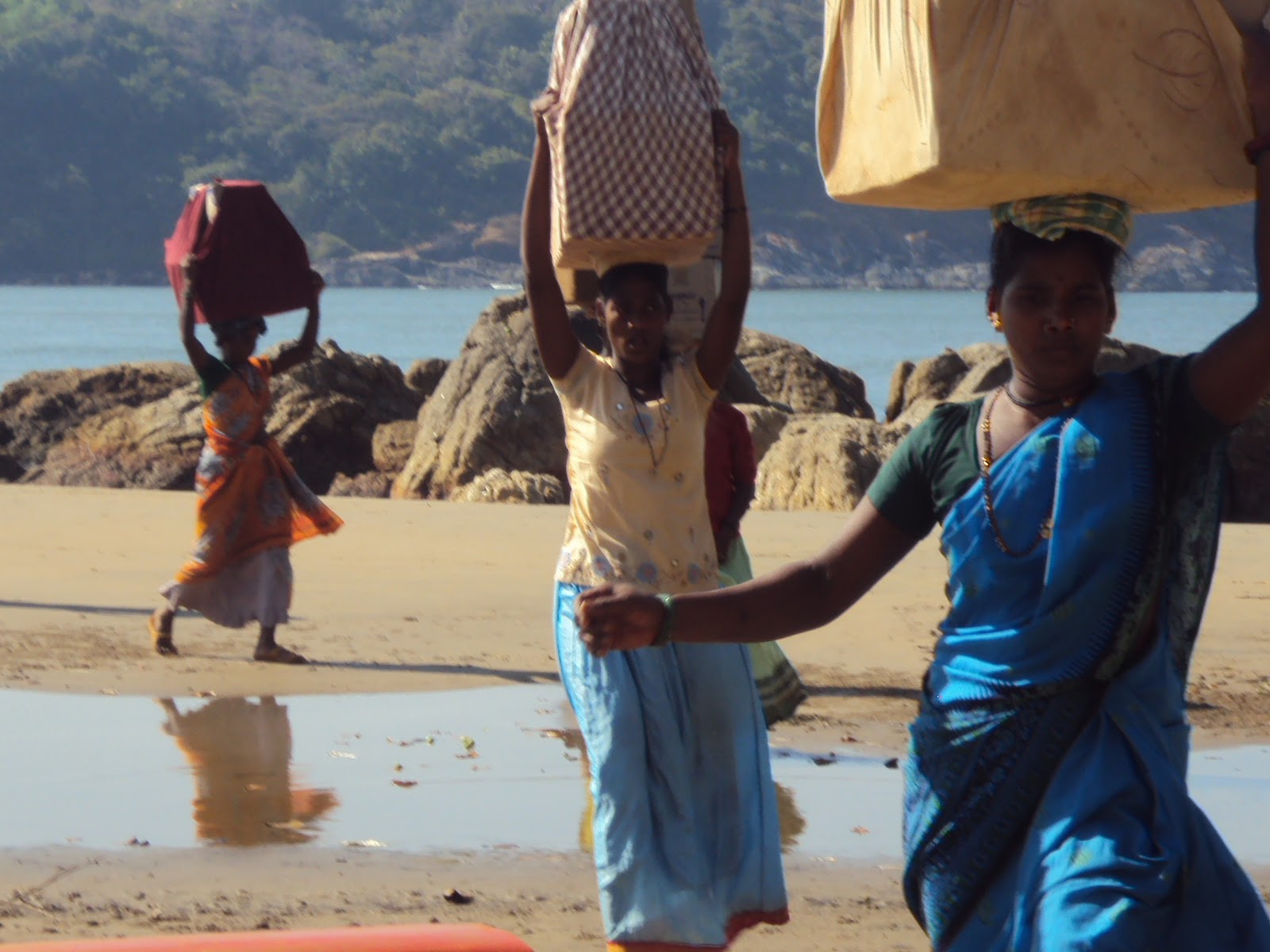
From the far side of the beach comes a procession of nine India women carrying cardboard boxes on their heads.  As they get closer I can see that the cartons contain bottles of drinking water.


This beach exists out of time.  Out of place.  This is not India.  This is not 2012.  It's a spot on earth filled with smiling people with radiant eyes saying "Hello," or "Nameste." Co-existing like people from a utopian fantasy.  From Italy, Amsterdam, Germany, France, Spain, Turkey, Israel, England, and America.  At sunset they gather on the beach.  Watch the sun turn into a glowing crimson globe.  The sky streaked with yellow,  gold,         vermillion, scarlet, purple.  And when the sun finally sinks into the sea they all cheer and clap.  Here none of life's daily miracles is taken for granted. Then we form a circle.  Dig a hole in the middle.  Place a candle and light it.  Musicians play drums and flutes and guitars and violins while I dance before the dancing sea.